
Becoming an AEDP Certified Therapist
Five Steps for Certification
- Achieve AEDP Level 3 (see AEDP Levels Defined).
- Select your Certification Supervisor, who will guide you in preparing your certification package.
- Submit your Certification Application to the Certification Coordinator, Carolyn Fitzgerald.
- Prepare your Certification Package with your Certification Supervisor according to the guidelines below
- Certification Supervisor submits their recommendation
Guidelines for Therapist Certification
Part I: Certification Package – What Should Be Included
Your certification package should include:
- Proof of State License (or equivalent certification from your region or country).
- Two audio-visual clinical sessions from two different clients (see detailed guidelines below).
- English transcripts for each video, with exact words and timestamps. For non-English videos, provide English subtitles aligned with transcripts.
- Microanalysis for each video (see Part III below).
- Client descriptions for each video, detailing treatment processes and client background.
- Self-reflection paragraph on your AEDP learning journey, focusing on growth and integration of AEDP principles. Avoid naming supervisors; reviews are anonymous.
Part II: Guidelines for Selection of Clinical Video Recordings
Video Selection
- Video 1: Early treatment (Sessions 1–4) with a new client
- Video 2: Mid-to-late treatment with a different client
Video Length
Each video should be 25–40 minutes, with a maximum of two edits. If editing is not possible, clearly mark transcript start/stop points.
Video Content and Highlights
Videos should demonstrate work across relevant AEDP states:
- One video should include State 1 work (defensive processes and work with anxiety) and State 2 work (processing core affective and relational experience through to completion), leading into at least the beginning of State 3. If space allows, this may also include completion of State 3 and movement into State 4.
- Another tape should demonstrate State 2 work through completion, leading into State 3, followed by States 3 and 4 work (metatherapeutic processing).
It is acceptable if sessions naturally move through 3 or all 4 states. The focus is on your use of AEDP interventions and how you guide the process, rather than solely on the client’s state transformations.
Videos should allow reviewers to observe moment-to-moment clinical decision-making, experiential and relational guidance, metaprocessing, and metatherapeutic processing.
*It is not necessary to have the therapist visible in the videos but adding detailed descriptions of nonverbal expressions and responses in the microanalysis sections is helpful.
Helpful Resources
- 4-State/3-State Transformation Phenomenological Model
- AEDP’s 9+1 Affective Change Processes Informing Interventions
- THE 9+1 INTERVENTIONS SCALE: SESSION RATING FORM
- AEDP 9+1 Short form
Tips for Videotaping
- For Zoom sessions, use Gallery View to capture both client and therapist.
- For in-person sessions, mirrors may help capture somatic responses from both parties.
Consent Reminder
Obtain written consent from clients to share recordings.
Exceptions
For settings where video recording is not permitted (e.g., hospitals or agencies), limited exceptions are allowed, including audio recordings or role-playing exercises. All exceptions must be pre-approved by the Certification Committee.
Part III: Format for Microanalysis
Include a microanalysis for each clinical session. This helps reviewers understand the theoretical foundation of your interventions and provides an opportunity for self-reflection.
Format Options:
- Transcript with annotations – verbal content in regular print, non-verbal cues in italics, therapist commentary in bold [brackets]. Follow the guidelines for transcript in an article (for example, look at articles in Transformance journal); example:
04:10 Th: If instead of doing the “so what” with a joke, or “that’s life,” [urging patient to relinquish defense]
Pt: Uh huh
04:21 Th: If you let yourself stay with this feeling (slowing down, sobering ), the sense of emptiness, this inner sense of (deep sigh, grave tone of voice )… having to work so hard to keep something away. [affective resonance]
Pt: Yeah… (also slowing down and sobering ) it’s tiring. [deepening experience]
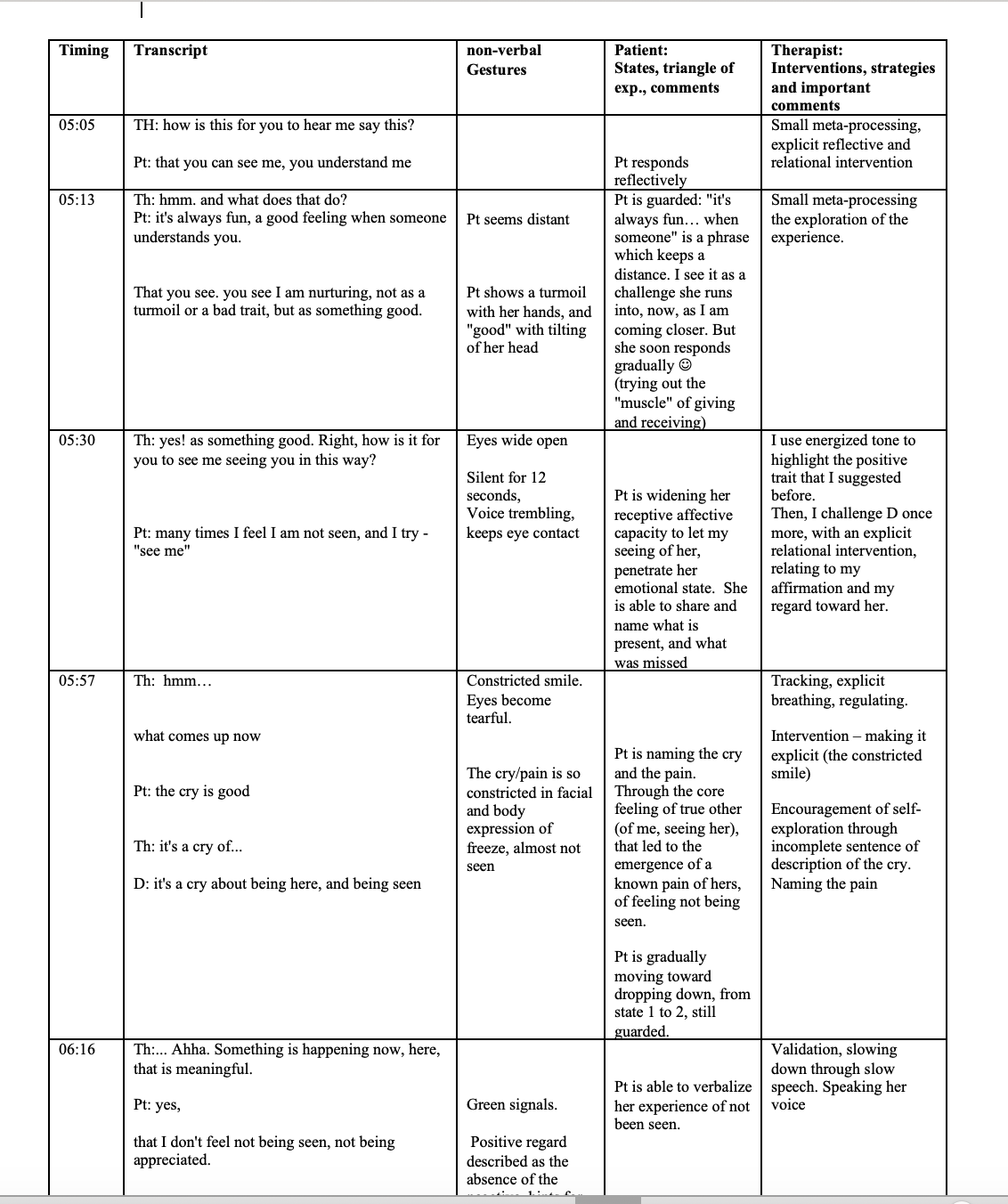
04:33 Th: It’s very exhausting (amplified exhausted intonation )… Mmmmmm…. [amplifying affective experience] I mean right now it seems to me like we’re sort of approaching this from the outside because it’s a scary place to be [empathic identification of fear]. - Grid format – video content on the left, interventions, theory, and process commentary on the right. you may want to look at the transcripts in the AEDP 2.0 examples); example:
Part IV: Review Process
- Your Certification Supervisor will submit a recommendation letter to Carolyn Fitzgerald (Carolyn.f@aedpinstitute.org), confirming the package meets guidelines and readiness.
- Upon submission, candidates receive a HIPAA-compliant AEDP Dropbox link to upload materials.
- Two reviewers (typically one faculty member and one certified supervisor) are assigned. Review takes up to 10 weeks.
- A $300 certification fee applies; an invoice will be sent once reviewers are confirmed.