Dear AEDP community,
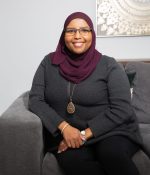
It is with genuine delight that I write to announce that Suad Mohamed is now a certified AEDP therapist. Suad who practices in Vancouver, B.C., has worked in individual supervision with me for the past three years.
I first met Suad in Jacquie Perman’s BIPOC Core Training supervision group. I was guest supervisor, and Suad presented her work with a young, highly dysregulated woman who would have been a challenge for any therapist. I was struck by Suad’s skill, and by her ability to hold boundaries with compassion and kindness, while maintaining her own poise and self-regulation. That was four years ago. Since then, I have gotten to know her as the wonderful clinician that she is: skilled, poised, compassionate and caring, and very attuned. Over these last three years, I have also seen the development and deepening of her AEDP skills.
In these last three years I have also witnessed remarkable growth in her therapist self and in her use of the self of the therapist in clinical work. She used supervision not just to hone her technical skills and learn the model—she took chances and brought to supervision difficult patients and sessions where she herself was having difficulty. Through her openness and her willingness to be honest and vulnerable, we walked the delicate line between supervision and personal work, staying pretty closely on the supervision side of things, though quite adjacent to the other. That work allowed her to have a breakthrough and add to her other skills and qualities the confidence to be bold and self-assured, and thus to do deep work with patients from the get-go, confident that she can handle what emerges. She now goes for it—and she does so beautifully, maintaining attunement, deep embodied presence, and her respect for the patient’s agency, in the process evidencing many if not most of the 9 affective change processes. The +1 is very much in evidence as well.
Another feature of our supervision was the way we wove into our work discussions of our differing social locations, exploring similarities and differences between us. We traversed what could have been challenging terrain with openness and honesty—openness to listening and sharing, and honesty about our respective feelings. In the process, we grew a bond that allowed us to do deeper and deeper work.
Now, I want to speak to something that has emerged in Suad’s work that I believe signals something important about where AEDP is heading:
A while back, Suad brought for supervision a session with a BIPOC patient, a woman struggling with depression and non-adaptive anger outbursts toward significant others in her life, each pathogenic aspect only exacerbating the other. With the clinical skill and attunement, Suad guided her patient toward a rage portrayal. I expected the rage portrayal to be toward the family member who was first discussed; however, while the rage portrayal began there, it then shifted to a portrayal of rage against patriarchy, against white supremacy, against white privilege, against racism and chauvinism, and so on. I was preparing to remind Suad that with portrayals, the more specific and focused they are, the better. Which, by the way, I am sure she knew. However, I decided to keep watching, since she was clearly excited about what was happening and wanted to share it with me, though she had her own questions. As I kept watching, I saw unassailable proof of transformation. Post portrayal, this formerly depressed, frustrated and discontented woman, who never seemed able to rest, moved into transformational affects, and then into core state and a state of deep calm—and into deep spontaneous insights about the nature of her anger, about the difference between maladaptive anger and adaptive anger, and about the difference between the experience of anger as she had had it in the session and the acting out of anger toward others in her life, which had never been satisfying and had always left her uncomfortable.
I recommended to Suad that that be one of her certification tapes.
I am going into it in some detail because, while an unorthodox portrayal, it was a powerful and effective one.
And furthermore: as I know from witnessing Suad do subsequent such portrayals against systems rather than people with other patients with oppressed and/or marginalized identities, in all of these cases, the portrayals are deeply felt, and deeply transformational for patient and therapeutic dyad.
I think that we are witnessing the birth of an innovative kind of work—breaking ground, allowing us to more effectively treat people of marginalized identities, and making a huge contribution to helping them heal. I have encouraged Suad to keep developing this work, with a view to in the not too distant future, sharing it with our community
However, for now, let me return to the matter at hand, i.e., Suad’s certification as a certified AEDP therapist.
Suad’s reviewers were clear in their assessment:
Reviewer #1 saw a therapist of “exceptional strength in undoing aloneness and dyadic coordination,” demonstrating “remarkable attunement,” with her patients having “a particularly strong sense of being accompanied rather than observed.” They observed that Suad “demonstrates strong AEDP core affective experience processing, particularly in her ability to track, deepen, and facilitate the client’s emotional experience toward completion.” What struck Reviewer #1 throughout was Suad’s consistent approach: her “pacing is consistently slow and attuned,” her “use of ‘we’ communicates that the client does not have to enter the difficult emotional experience alone,” and her “moment-to-moment attunement and willingness to enter the client’s emotional experience with her” conveyed genuine resonance. They noted that Suad stayed present as the client moved through her emotional material, with the “quality of her moment-to-moment attunement” creating space for transformation, adding that Suad “demonstrates a high level of presence and moment to moment attunement, consistently following the client’s emerging experience rather than imposing a predetermined direction,” and emphasized that “most importantly, the work remains focused on transformation.” The theoretical grounding was evident: Suad “demonstrates strong and nuanced integration of AEDP theory into her clinical work.” Reviewer #1’s final reflection captured it all: “This was a beautiful, deeply experiential, relational, and transformational [work] that reflected a strong integration of AEDP theory into moment-to-moment clinical practice.”
Reviewer #2 emphasized both the precision and heart of Suad’s work. This reviewer was struck by Suad’s “pressuring with empathy”— “steady, respectful, and celebratory of each spark of affective courage”—calling it “truly impressive.” They observed the patient’s transformation “from constricted and self-doubting to vigorous expression of Core Affect (and beyond!),” noting that she “reached an entirely revised sense of her Self.” The reviewer was especially delighted by Suad’s willingness to work at the edge: “I LOVED Suad’s use of pungent curse words to support her client’s affective expression. Beyond mirroring, this powerful ‘transgressive’ language seemed to help loosen some of the client’s constraints against expression of anger. From there, big freedom broke through!” They described Suad’s somatic work as “masterful” and “effective,” highlighting her “targeted focus on somatic prompts of the client’s deep, defended affect.” Reviewer #2 also noted Suad’s nuanced regulation: “Suad’s work’s subtlety is impressive. She ‘checks all the boxes,’ without huge fanfare but with skill and vigor.” In particular, they observed that Suad’s support of the client’s access to deep anger was “quiet and steady,” so the client “wasn’t scared away from the edge.” What stood out most was how Suad helped the client access and champion feared emotion—anger—without “coaching” her, clarifying the targets of her rage and making it safe enough to express. The metatherapeutic processing near the end of the session “really supported transformance” and helped it “stick,” while Suad’s shared delight in the client’s true affective experience strengthened the upward spiral, leading the client toward “new self-respect and empowerment. Brava!” Reviewer #2 concluded: “This is really solid, inspired AEDP. A pleasure to sit with Suad and her client.”
And, finally last but not least, here is Suad Mohamed in her own words:
“I first encountered AEDP in 2014 and was immediately intrigued by the way it spoke to both my intuitive knowing and analytical mind. I was drawn to its unique integration of scientific rigor with heart, authenticity, intuition, and deep relational presence. It was unlike anything I had encountered before. In 2016, I had the privilege of experiencing AEDP as a client. It was no longer something I understood intellectually; I felt it “in my bones” in a way I could not deny. Although I had already received formal training in other trauma therapies, I knew I had found my therapeutic home.
AEDP has profoundly shaped not only how I practice, but how I understand myself, others, and what becomes possible when we are met with genuine relational presence. It has taught me to slow down, attune more deeply to/with my whole self, and trust in each person’s innate capacity to heal, grow, and transform when met with safety, compassion, and authenticity. What continues to move me most about AEDP is its unwavering belief that no one is defined by their suffering. It offers a deeply experiential way of meeting people with curiosity and compassion, honouring both the pain they carry and the resilience that has sustained them, while trusting in their inherent capacity for healing.
At its core, AEDP’s commitment to undoing aloneness resonates deeply with my values and my dedication to fostering deep relational connection as an antidote to isolation, division, and trauma. This commitment has become a guiding thread throughout my work. Again and again, I have witnessed AEDP awaken transformance in both my clients and myself, in ways that continue to humble and inspire me. These moments continually reinforce my belief in the relational power of healing, not only for individuals, but also for families, communities, cultures, societies, and the systems to which we all belong.
Becoming certified feels like both a culmination and a beginning. I am filled with gratitude for the clients who have entrusted me with their stories, and for the mentors, faculty, supervisors, fellow experiential assistants, and colleagues whose wisdom, generosity, and presence have shaped my journey. I am especially grateful to Diana Fosha for her supervision over these years. Her warmth, steadiness, perceptiveness, and deep generosity have been a source of guidance and inspiration. She has a remarkable ability to see what is emerging, gently draw out transformance, and invited me to grow not only as a therapist, but as a person. When we began this journey, I imagined I would become a more skilled therapist. I could not have anticipated how deeply I would be transformed as a person. I feel more whole, more courageous, and more open-hearted.
My AEDP journey has taught me, time and again, that learning, healing, and growing are never solitary endeavours, but unfold through connection. I am deeply grateful to be part of a community that embodies this way of being.”
Please join me in celebrating Suad’s becoming a certified AEDP therapist and in looking forward to her contributions to the development of AEDP. In keeping with our listserv guidelines, if you wish to congratulate Suad, please backchannel your congratulations to to her at suad@connected-counselling.com
Diana